
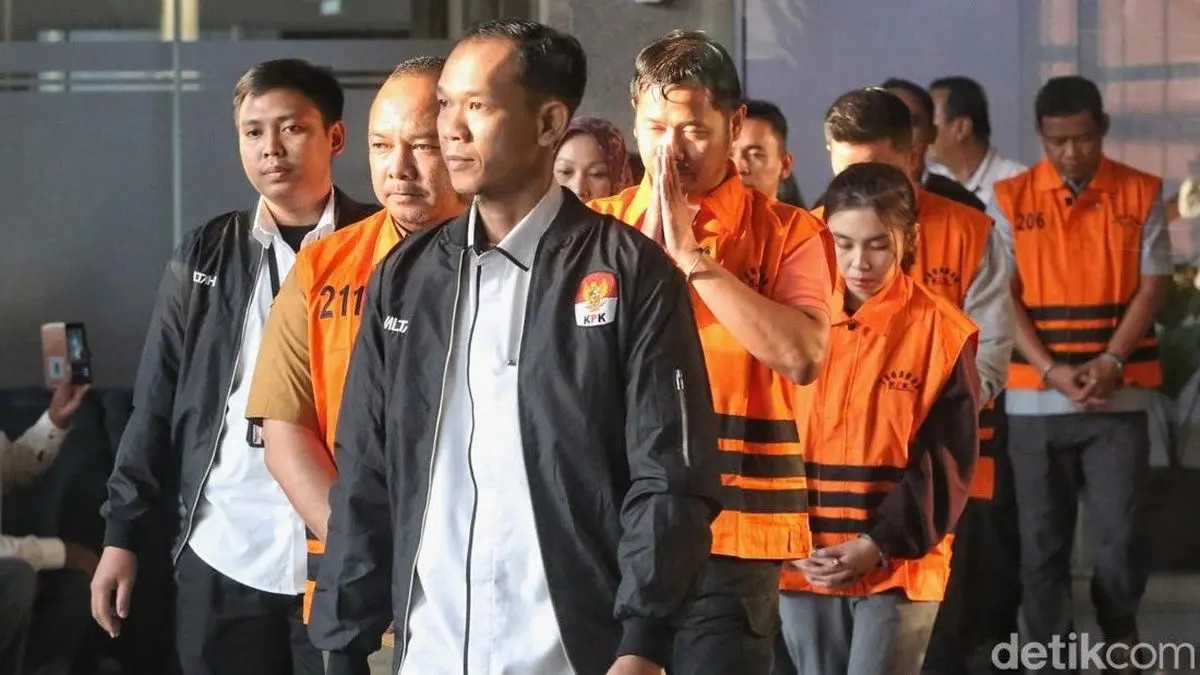
24-Hour Post-Sting Time Limit as the Primary Reason
The Corruption Eradication Commission (KPK) has explained its reasons for not charging five suspects in the alleged corruption of disaster ready-to-use funds (DSP) at the National Disaster Mitigation Agency (BNPB) with articles carrying the death penalty. The explanation was delivered by Acting Director of Investigations at the KPK, Achmad Taufik Husein, during a press conference at the KPK Red and White Building, Jakarta, on Friday (10/16/2026).
"As for why Articles 2 and 3 were not applied, colleagues certainly know that closed investigation activities led to a caught-in-the-act operation (OTT), meaning the KPK has only 24 hours to determine whether the status of the process advances to the investigation stage," Taufik said. According to him, provisions in the latest Criminal Procedure Code (KUHAP) require investigators to promptly name suspects when covert investigations culminate in an arrest.
The second consideration is the sufficiency of evidence uncovered by investigators. Following a case exposé, investigators opted to apply Article 12 letter i of the Anti-Corruption Law (UU Tipikor) regarding conflicts of interest, rather than Articles 2 and 3 which allow for the death penalty. The KPK highlighted the affiliations of several vendor companies with state officials and trusted confidants of the Head of BNPB.
Five Suspects and Two Case Clusters
The KPK has divided the case into two clusters. The suspects are: Gabriel Purwaka Sigit (Sub-directorate Head of Aid and Emergency Management at BNPB and commitment-making official), Bima Setiawan (expert staff member and brother of BNPB Head Lt. Gen. Suharyanto), Richard Erlangga (expert staff member to the BNPB Head), as well as Gery Prasetiawan and Syifa Nrika Ghifarian from the private sector.
Taufik added that the suspected conflict of interest pertained to multiple procurement activities for goods and services: "Because several procurement activities were affiliated with state administrators and relatives, relations, or trusted confidants of the Head of BNPB." DSP itself refers to funds whose disbursement is flexible, though it must comply with BNPB Regulation Number of 2020, which includes the declaration of a state of disaster emergency by a regional head or the president.
House of Representatives Urges Death Penalty
The KPK's explanation comes amid pressure from the House of Representatives (DPR). Member of Commission XIII of the DPR, Rieke Diah Pitaloka, urged the KPK to apply the death penalty pursuant to Article 2 paragraph (2) of Law Number 31 of 1999. The Indonesian Democratic Party of Struggle (PDI-P) politician argued that the embezzlement of disaster funds satisfies the element of 'certain circumstances' because it deprives disaster-affected communities of their right to life.
Rieke also demanded that the investigation be expanded using Article 55 paragraph (1) 1st of the Criminal Code (KUHP) and Article 20 of the Anti-Corruption Law to capture intellectual actors and vendor corporations, partner with the Financial Transaction Reports and Analysis Center (PPATK) to trace fund flows, and audit BNPB's institutional framework to prevent forest and land fire (karhutla) management from being crippled.
Door to the Death Penalty Article Remains Open
KPK Chairman Setyo Budiyanto signaled that the door to applying Articles 2 and 3 of the Anti-Corruption Law is not entirely closed. "This process is still ongoing. It does not rule out the possibility that later developments or new information might emerge, or other parties might be implicated, which does not rule out applying those articles (Article 2 and Article 3 of the Anti-Corruption Law)," Setyo said on the sidelines of the 2026 Media Safari event in Yogyakarta on Thursday (10/15/2026).
Precedents for imposing the death penalty in corruption cases are indeed narrow: in 2020, the KPK charged former Social Affairs Minister (Mensos) Juliari Batubara under bribery articles, not Article 2 paragraph (2). This case originated from a KPK sting operation on October 13, 2026, which apprehended 14 individuals over the alleged misappropriation of funds originally intended to address forest fires in Kalimantan and Papua, earthquakes in East Nusa Tenggara (NTT), and flooding in Aceh and Sumatra.


No comments yet. Be the first!